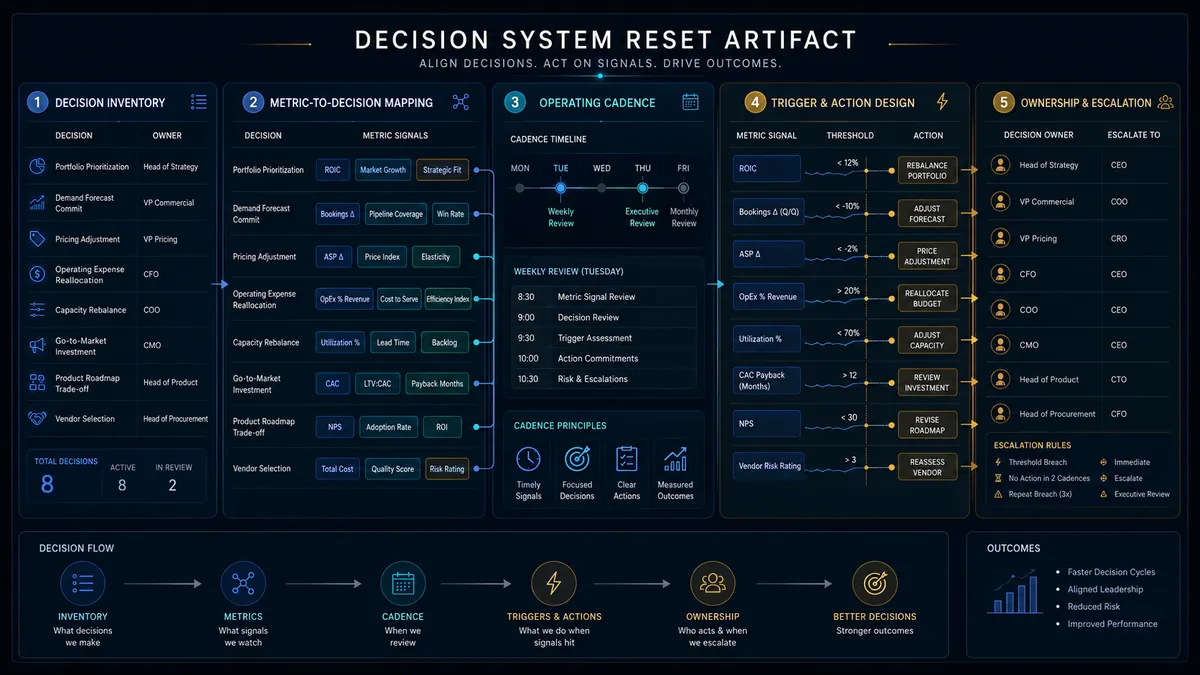
Turn disputed metrics and BI dashboards into decisions leaders can run.
Parallax rebuilds the decision system around analytics and BI reporting: what decisions matter, which metrics inform them, who owns action, what triggers response, and when escalation should happen.
Replace implicit, debated decision-making with an explicit system for action.
01
What decisions exist
Clarify the business decisions leaders are expected to make and remove decisions that should not exist.
Example
A weekly "performance review" becomes three explicit decisions: pricing action, staffing adjustment, or no change.
02
Which metrics matter
Separate signal from noise by mapping metrics to decisions, thresholds, and intended action.
Example
A dashboard with 18 KPIs becomes 5 operating signals tied to renewal risk, capacity, and margin action.
03
Who owns them
Assign clear ownership, authority, and accountability for each decision and response path.
Example
Analytics informs the signal, but Sales Ops owns response timing and Finance owns margin tradeoff approval.
04
What triggers action
Define when a metric movement requires response, escalation, or a change in operating behavior.
Example
If cycle time rises above threshold for two weeks, the owner escalates constraints before the monthly review.
05
How escalation works
Redesign review cadence so meetings move decisions forward instead of recycling reports.
Example
Recurring report meetings become exception-based reviews with owners, thresholds, and next actions documented.
Who should participate
A reset works best when the people who own the decision, data, and reporting cadence are represented.
The goal is not to pull everyone into every working session. It is to make sure the right viewpoints are included so the reset reflects how decisions are actually made, measured, and reviewed.
01
Executive owner
Confirms the business priority, decision authority, tradeoffs, and what success needs to look like.
02
Analytics or data owner
Explains the data model, metric logic, definitions, constraints, lineage, and technical feasibility.
03
Functional decision owner
Owns the recurring business decision the metrics are supposed to inform and clarifies what action should follow.
04
Recurring reporting owner
Knows the current dashboards, review cadence, manual workarounds, report dependencies, and friction points.
Optional
Decision-area partners
Finance, customer success, operations, sales, or other domain owners should join when the decision area depends on their operating context.
What we fix
Five parts of the decision system get organized into one operating model.
Each part is treated as connected infrastructure, not as a separate reporting request. The reset clarifies what leaders decide, which signals matter, who owns response, and how action happens.
Decision inventory
Clarify decision intent, frequency, authority, and duplication so leaders know what needs to be decided.
Metric-to-decision mapping
Connect metrics to the decisions they support and remove measures that create noise or false confidence.
Operating cadence
Shift review meetings away from slide consumption and toward decisions, ownership, and next action.
Trigger and action design
Define thresholds, responses, and escalation paths so teams know what happens when metrics move.
Ownership and escalation
Make responsibility explicit so analytics informs action without becoming the owner of every operational response.
What you walk away with
A visible decision operating system your team can run after the engagement ends.
The deliverables connect decisions, metrics, owners, thresholds, reporting assets, and meeting cadence. Each artifact is designed for operating use, not as a recommendation deck that gets archived.
See whether a Decision System Reset is the right next move.
All reset work begins with a free fit check. If deeper diagnosis is needed, the paid Analytics Health Check maps the issue first. The Decision System Reset creates the system; Fractional Analytics maintains and evolves it.