Predictive decision frameworks
Signal models that help leadership identify risk, churn, instability, or operational friction before it becomes obvious.
Parallax Intelligence Lab
Intelligence Lab is the advanced layer built after reporting reliability, governance, and decision context are strong enough to support predictive intelligence, monitoring, machine learning, and AI-assisted decisions.

What this is
Most analytics work restores trust in the numbers. Intelligence Lab starts after that: when leaders need a repeatable digest or signal product that turns trusted data into prioritization, risk detection, governance, and action.
Signal models that help leadership identify risk, churn, instability, or operational friction before it becomes obvious.
Semantic models, access rules, metric logic, and business definitions that make advanced intelligence trustworthy.
Digestible systems that surface what changed, why it matters, and where leaders should focus next.
Where it fits
It is the advanced build path when the foundation is ready for intelligence products. The full services breakdown lives in Our Offerings; this section is here to help you orient quickly.
Best fit
This is strongest for teams with a real decision problem, enough data to learn from, and a need for repeatable intelligence rather than another static report.
Teams managing risk, performance, churn, compliance, or operational variance across functions, sites, or regions.
Teams that have dashboards in place but need prioritization, detection, forecasting, and guided action.
Teams that need models, access rules, definitions, and executive outputs to hold together as the system grows.
How we build
The Lab does not start by asking what model or dashboard to build. It starts by making the decision system explicit: what leaders need to know, which signals prove it, who owns the definitions, and how the insight turns into action.
Define the leadership decision first: what needs to be prioritized, predicted, escalated, or explained?
Identify the operational, customer, financial, workflow, or behavioral signals that actually indicate change.
Align definitions, access rules, model ownership, and metric logic before automation makes the system louder.
Design the digest, alert, framework, or executive view around who acts, when they act, and what changes next.
What Intelligence Lab becomes
Intelligence Lab is where trusted reporting evolves into predictive intelligence, machine learning applications, AI-assisted decision systems, operational monitoring, executive intelligence products, proactive risk detection, and workflow-triggered insights.
Evidence of advanced work
Open each initiative to see how the Weekly Operational Intelligence Digest and related intelligence modules turn signal into leadership attention and action.
 Operational intelligence
A live-style weekly digest showing how scattered operating signals become a ranked leadership attention queue.
Open interactive product Governance architecture
A working access-control example showing how one analytics experience can safely serve multiple audiences.
Open interactive product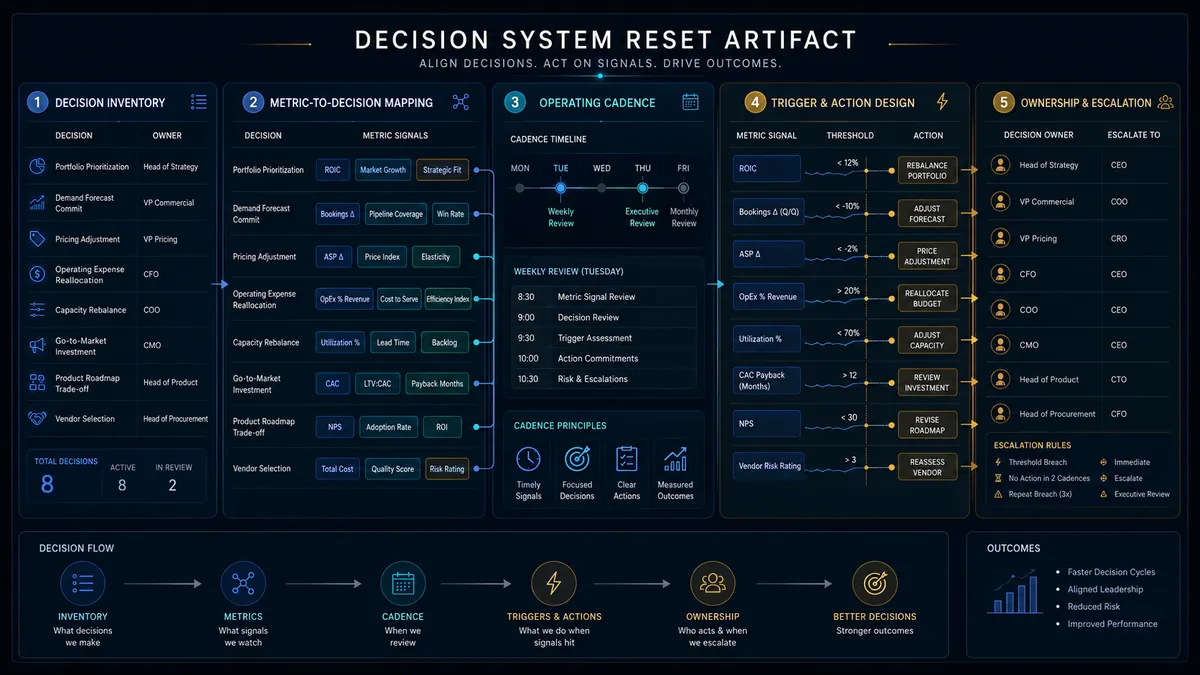 Reset artifact
The working artifact teams use during a Decision System Reset to rebuild decisions, metrics, dashboards, ownership, and action paths in one place.
Open workspace product
Outcome systems
An executive-facing example of organizing analytics work around measurable business outcomes and proof of value.
Open interactive product Predictive intelligence
A decision framework showing how risk signals, scoring logic, and explanation layers can guide earlier action.
Open interactive productBoundaries
Clear boundaries keep advanced intelligence work focused on decision systems, not endless reporting requests.
We do not operate as a ticket-based reporting team.
We do not replace the primary data engineering function of record.
We do not rebuild upstream ETL as part of standard intelligence work.
We do not automate decisions until definitions, owners, and action paths are clear.
Start with a clear read on whether your foundation is ready for predictive frameworks, governed intelligence layers, and executive decision products.